Showing posts sorted by relevance for query p7. Sort by date Show all posts

Tuesday, November 23

First Flight of the P7


Maserati, Seen in the Doctor Parking Next to the Entrance to Baylor Grapevine Medical Center on Monday. Doctor Visit 3 of 3 for the Day
Don't Those Doctors Understand? - "Alfa Romeo, es mas macho."

Veggies Need Not be Starchy!
I’ve used Cateye headlights a lot, but it is time to move on. I’ll keep them for occasional use in ways that their shortcomings do not cause problems. To replace them, I have acquired a “2W Planet Bike Blaze” and a P7-C. The P7 actually came on Monday, though I couldn't have used it, instead spending the day discovering how my medical adventures have affected local doctors, and allowing my local restaurant to prove that dinner side dishes need not be starchy. Anyway, this morning I used the P7 and it is a great light as long as one is prepared to live with its idiosyncrasies. While I haven't done too much fact checking, I've heard that the P7 uses the brightest available single LED to make its light. It certainly IS bright whether that claim is true or not.


Bike With Lights Turned Off
Apertome reported on the light and on a battery recall involving it here, and here. I must admit that the battery/light interface is certainly rather strange. Unlike any light I’ve ever seen, the on/off button is lit when the battery is hooked up – and stays lit. The situation is compounded by instructions that are worse than worthless.

The light itself, however, is brilliant, albeit with a fairly wide beam. No matter – it’s got so much light that it is brighter than any of my other lights, including the fatally flawed Cateye HL530 with fresh batteries. On the high setting, the maker claims 3 hours of light. On my new commute, that’d be about a recharge once a week. On the v2 commute, it’d be a recharge every other day. The light is also very solidly built and doesn’t depend on an unreinforced plastic mounting bracket the way the Cateyes do.


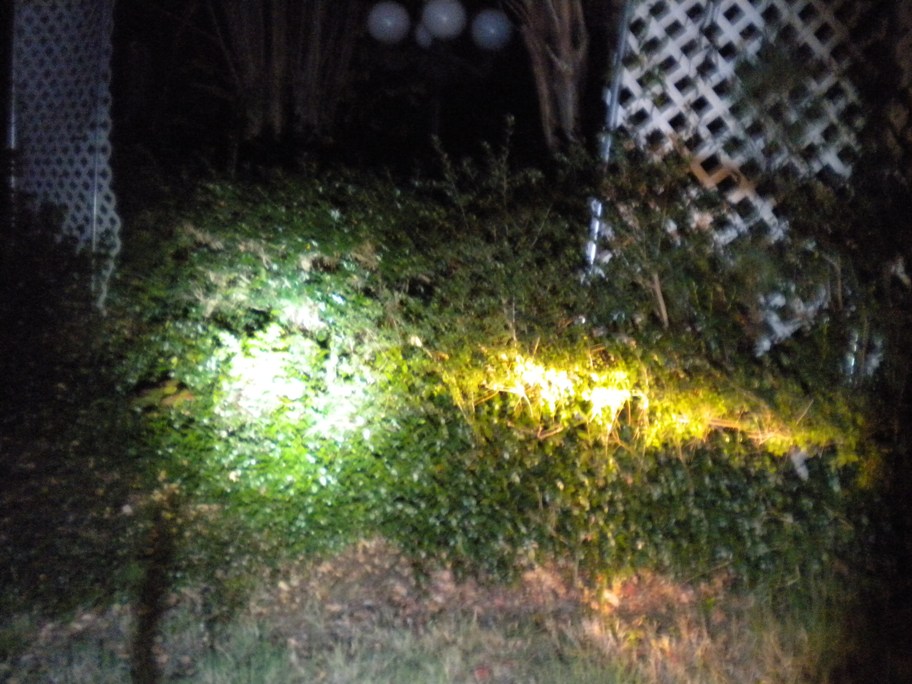
P7 in "High" Mode. Note that Street Color Sets the Brightness on Each of These Three Photos

In addition to the “high” mode, the P7 also has a “low” setting and a “flash” setting. I don’t think I’ll use the "flash," instead I'll ride with high when there's no oncoming traffic and drop it down a notch when all I need is to be seen.

So far, the P7 does what it needs to do – light up the way forward.

Should you consider a P7? Well, it definitely isn’t a light for everyone. For starters, it probably isn’t available in your local bike shop, or even on Amazon ("unavailable"). I got mine off eBay and Apertome got his online. For a second reason, as noted by Apertome, the batteries and battery/light interface is suspect. This might or might not get better in the future. It also throws a broader beam than is optimal for a headlight - I worry about blinding oncoming motorists, which is why I'll operate it as I would an automotive high/low beam combo. ON THE OTHER HAND, the light is half the price of any equivalent lighting power and gives you the lighting of a generator light without the weight, drag, cost, and complexity. Simply charge this puppy up – and GO. Perhaps, tomorrow, I'll find out how it does in the rain...

P7 in "Low" Mode is About the Same as the Planet Bike 2W Blaze on "High"

Friday, December 10

P7 Lights up the Night

Previously, I reported on the shakedown cruise of the new P7 lights. Since then, I have discovered how they act when the batteries get low and I took a few night shots tonight when we went to look at Christmas lights. All photos were shot with an iPhone. The camera I brought insisted I had to have flash which sort of defeats the purpose. I did not adjust any of the photos. My daughter said it is about the same brightness as one of our Land Rover headlights (SEE BELOW).

As for how the light acts when the batteries are low. THAT is very simple. The light remains identical to what is shown until they blink out as if someone shut off a switch. My lights lasted a little over three hours on the high setting. For my current commute, that means I'll be charging them once a week. The low setting is MUCH lower. The low setting is about the same as the high setting on the Planet Bike Blaze 2w light. I think one reason they LOOK exceptionally low is that the high setting is so bright.

The Light Action on an Unlit Residential Street. Cyclist is About 10-15 Feet Ahead

The Light Action on a Four Lane Road. Cyclist is About 30 Feet Ahead

License Plate Reflection on a Residential Street

Light Action on Residential Street
After this, I got to thinking and we tested that theory that the P7 is about as bright as an automotive headlight. P7 versus a VW Jetta pair of headlights. YOU be the judge. The P7 beam is to the left of the two Jetta lights. In fairness to the little Nazi car, the contest is less one-sided if the VW puts its high beams on.

P7 Light at Left, VW Jetta Lights to the Right. Note the Intensity, as Well as the Light Beam Pattern.
I Typically Aim the P7 a Bit Lower So as to Not Blind People

Monday, December 3

Achilles Heel


As Achilles Had His Heel, the P7 Has Velcro

Many times I've extolled the virtues of the mighty P7 headlight I use on my morning commutes. It is brighter than any light I've seen that is twice the price. What's more, it has outlasted any Cateye light I've had. Still, it does have its own weakness; its Achilles Heel.

The P7's battery is its weakness. Well, not the battery, exactly, but the Velcro that is supposed to keep the battery attached to the frame and hence the light. I have now lost this battery three times and have also doubled back to find it three times. There is something to be said for buckles or snaps. A light whose battery falls off while lit is an obvious event. A light whose battery falls off, randomly, while unlit after dawn is more problematic.

Mighty P7 With Battery Attached

Wednesday, April 20

A New Meaning for "Burning Up the Night"

My P7 light has always been a bit suspect, though it really DOES burn through the darkness. Apertome reported that an almost identical "SSC" light was getting recalled. Well, today, I saw the recall notice. It may be found here. It's a joint press release from CPSC and Health Canada. Interestingly enough, the recall was quite specific, considering that basically the same product has been sold under many different names.

Also, interestingly, when I went out to look over my own box and instructions carefully, I didn't find ANY of the information contained in the recall, though my battery looks like a "Series I." I guess it didn't occur to CPSC that the light might be sold by other outfits than the one that initiated the voluntary recall. They ask if people have had OTHER problems with lights from the indicated supplier, but not if people have the same light from other suppliers. Our government at work...

Regardless, my light continues to work well and I've never noticed the batteries even getting hot, much less burning up the night. Considering that it seems to have been better designed than at least two different Cateye headlights, and it hasn't even broken ONCE (unlike Cateye) I think I'll continue to use it, since I have no idea where I'd send it back to.

P7 Light at Left. VW Jetta High Beams at Right.

P7 Light Looking All Innocent


P7 Light in the Morning


Saturday, March 9

Lighting Serendipity


I'm Not the ONLY One Who Wanted a Better Light Lens. Anyone Vote for This as Such?
In my post, here, I bemoaned the battery case on my Mighty P7 headlight getting old and tired. A number of good suggestions were received, but the solution turned out serendipitously thanks to a completely unrelated suggestion.

One problem with these headlights is that the beam focus is not as clearly defined as I might like. In an attempt to “fix” things, there is now an aftermarket lens manufactured for these lights. I’m not sure that this lens is for me since it looks like it makes the beam wider, but doesn’t do much for the vertical focus. I’d really be interested to hear if my loyal reader has tried this new lens or has seen one in person.
 
New, and Truly IMPROVED Case for the P7 Battery - Now in the Steve A Light Group
But I digress. While looking for this lens, I ran across REPLACEMENT BATTERY CASES. For $5 and better features, it hardly seemed worth a “do it myself solution.” And yes, the new case works far better than the original ever did.


The Old, Original P7 Battery Case. Now in Retirement
 

Tuesday, February 8

Deja Vu Sorta

New Gas Station Along the Old Route
Cheap Coffee and Hot Dogs for Cyclists
They say you can't go home again. In some ways you can't go to work again. Well, at least if you go to where you USED to work, it just isn't the same. Not exactly, anyway.

Since mid November, as reported in this post, I haven't commuted to Fort Worth Alliance Airport any more - until today. It was Deja Vu All Over Again, and then it wasn't.

For those who don't know the particulars, I regularly made the 40-mile roundtrip commute from home to Alliance Airport from April 2009 through Remembrance Day of 2010. During that time, I put the better part of 6000 miles on Buddy, more miles on other bikes, and I and learned a lot about how a transportational cyclist can successfully operate in a vehicular manner over all types of roads in all weather and lighting. Every day. My v3 commute, by comparison, is about 7 miles each way. The difference is a lot more than just the mileage, as I was reminded today. I did the old commute again because I needed to take care of some administrative stuff with my engineers at Alliance, and I expected it would take pretty much the whole day. I looked forward to deja vu on the old commute with a little trepedation mixed in. It'd be fun, but sometimes reliving old experiences reminds us of what we didn't enjoy rather than our memories that grow fonder with the passing of time.

It all started out real familiar. I rolled out of bed about 45 minutes earlier than my new commute, and was ready to depart in plenty of time. Other than having to remember not to make an early LEFT turn, it all seemed familiar. In fact, it was SO familiar that the main difference I noticed was that the mighty P7 light eliminated any past questions about whether the video traffic signals would recognize the forward progress needs of the commute cyclist. I must say I highly recommend a bright, steady headlight to trigger those video-triggered traffic lights. In fact, I triggered them easier than my motorists along the route. About the only other differences on the way to work in were my thoughts - about 1/3 of the way to work, the thought hit me that if I were making my new commute, I'd be at work. About 2/3 of the way to work, the thought hit me that if I were making my new commute in the worst weather in recent memory, I'd be at work. Still, the ride itself seemed just like it used to be in the predawn darkness. When the sun peeked over the horizon, I was nearly at work and simply noticed a few more new houses in the developments close to the Alliance Gateway Freeway. It was as sweet as ever to head up the last stretch, and then finally move into the left turn lane to turn into the parking lot.

Then, I brought the bike inside and started to notice not everything had remained unchanged. I experienced Obamacare first-hand when I encountered our former shower that was now locked, thanks to the "nursing mother" provision. Then I found that the cafeteria doesn't have chorizo for omelets any more and they'd changed cooks. What's more, there was no green salsa. Well, none of those were strictly commute related, and there is another shower in the building. It was fun to see people who KNEW I was there because "Steve's bike is here" in the office I was borrowing. Still, Alliance seemed a little less legendary. The larger differences became apparent on the way home. Homeward bound is the real test anyway more often than not.

The first big difference was that, in contrast to early November, the trees looked dead. My daughter, Abbey A, really was the first of our family to observe that it looks really DEAD in Texas in winter.The grass looked dead too. It's Texas winter. No more color for these cowboys and cowgirls until the weather warms up seriously. Somehow, I didn't notice that change nearly so much on my new commute, but seeing dead-looking trees again that were full of leaves the last time I'd seen them made an impact that hadn't been apparent in the morning darkness.

Color or B&W, the Scenes Look Pretty Much the Same. Even the Grass is Beige

Gratuitous Bike Shot to Provide a Little Color
Then, as I rode along, I noticed that pockets of snow remain from last week's ice and snow event. We may not be in the snow belt, but even Texas still has some, and more is expected tomorrow. Maybe quite a bit more. We shall see. More things one didn't notice in the predawn ride in to work. There certainly was none of this stuff around last November.

Snow on a Roof in Keller, Texas

Snow Remnants in a Yard in Keller, Texas
On a more serious note, there were still remants of the gravel and sand used to provide traction near the intersections. In the predawn darkness, a cyclist could easily go down if he weren't in the habit of riding in "the line of sweetness." As it was, the sand made a lot bigger impression on me when I could actually contemplate it at the leisure of a red light. This CAN'T be good for the drivetrain!

Note all the Sand at the Intersection Approach. I Can't Remember WHY I Appear to be in the Right Wheel Track. I Usually Approach this Light
From the Right Side of the Left Wheel Track. It May Have Been the Other Photos I Took That Led Me Astray
You Don't Notice This Stuff So Much in the Morning Darkness when the Mighty P7 Makes all the Lights Change

One thing that also was different was seeing a coyote on the way home, only about four blocks from Colleyville City Hall. I've often seen coyotes on the way to Fort Worth Alliance Airport, but usually fleetingly and in the dark or dawn. This was the first time I've EVER seen one in the late afternoon in a fairly mature neighborhood. Remember y'all, keep your cats indoors! Those coyotes are more hungry than usual this time of year.

Colleyville Coyote. This is the First One I've Actually Gotten in Pixels. He Doesn't Look too Fat to Me
A Coyote in an Urban Setting at 5:30PM Suggests These Guys are Extra Hungry

There were also differences in ME. For one thing, influenced by my new commute, I wore work pants for the commute. They worked well in the 30F morning ride, as well as for the 50F evening return. High vis cuffs finished off the look and kept wind from blowing up my leg as they kept my pants away from the chain. Simple and effective - and they keep the "High Vis Police" at bay. Sorta.

Work Pants Work Well for a 20-Mile Winter Commute

What's in a Man's Purse?
Buddy was pretty much the same. About the only change from the "good old days" was the addition of the MIGHTY P7. I was very careful since it's only got three hours on the high setting and I like to charge it on the weekends. Still, there WAS time to stop for coffee on the way home. Asked where I'd been recently, I noted I'd been transferred to Hurst, but I got to to to Alliance for the day. Those baristas have memories like elephants!

Buddy and the Mighty P7, Reclining at a Store of a Major Coffee Chain I Have Neglected Recently
The final change was on the very last leg home. How THOUGHTFUL of Colleyville to add a "cyclist potty stop" at the locale where construction might cause some cyclist delay. I really hadn't noticed the added cycling facility on the way in to work.

However, in all seriousness, I think the new v3 commute has softened  me a bit. I certainly encounter a lot less motorists on narrow, two-lane roads than formerly, and there aren't any high-speed, divided roads on my new commute that compare to the Alliance Gateway Freeway. The combination of the longer distance and the tough (in spots) roads, sharpened my skills and my awareness of developing traffic situations in a way no other method could have done. I deeply appreciate those lessons, but, in some ways, you really can't go to work again - unless it's more than just for a day. I'm also thankful that I didn't complete LCI training when this was my regular route. Even as it was, there were a few moments when I felt like I represented the bike-ed version of the "Provisional Wing of the Irish Republican Army." A little softening isn't necessarily bad...
I Don't Think the "Turn Around Don't Drown" Sign Refers to the Portapotty...

Monday, January 3

Blowing Air


Venus, the Symbol of Friday, or, in "French Canada-Speak," Vendredi. From Wikipedia
 Over the Holidays, I went and fixed all the family bikes. While bikes may have some of the same DNA as old English cars, they’re a lot easier to fix. Unlike old English cars, bikes have a greater propensity to lose air from their tires unexpectedly in a rapid fashion. This has caused a reassessment and an actual RESOLUTION to modify my bike commute routine for 2011. It is ironic that, only yesterday, I sorta sneered at the whole practice of New Years Resolution making.

Sleeping, From Wikipedia
My past commute routine has been to top off the air in my bike tires Sunday night or Monday morning. Typically, each tire will require about four strokes of the floor pump to reach full pressure. On occasion, something will go wrong, like the tire will be flat when I go to pump it or it will clearly have lost an abnormal amount of air. Of such events are part of why the “ABC Quick Check” is a recommended routine action. Well, last night, to get a jump on the New Year, I pumped up the tires on my commute bike a little early; Sunday night. As I put the pump head on the front tire valve, came a “psssss” sound that clearly indicated a problem. Since it was SUNDAY NIGHT and not MONDAY MORNING, there was no rush or panic. I simply took off Frankenbike’s recently repaired front tire and put it on Seth. No need to even disturb my spare tube. No fuss, no muss. Oddly, this caused me to double check the Planet Bike backup light and, sure enough, its batteries had died. Had I forgotten to recharge the P7 Light’s batteries, I could have been lightless (well, I would have been reduced to using a Cateye light, anyway). Since I overslept this morning, the temptation to drive would have loomed. Even with the v3 commute, it’s still quicker in raw time to drive than to ride, because I can dispense with having to listen to the weather report before departure.

This serendipitous failure caused me to resolve to revise my commute routine. Henceforth, I resolve to top off the air in my tires and recharge the P7 Light’s battery at the end of the week's commute (FRIDAY) rather than waiting until Monday morning. This routine change has the advantage that if “unroutine” occurs, I do not have to scurry around to fix it quickly for the Monday morning commute. I can even pick up a replacement item at the bike store if need be, which Sunday night checkout does not support.

PS: In retrospect, since Frankenbike is all fixed, I could have taken Frankenbike today, but that would have involved a bit of changing around of lights. Those tool-free brackets, despite what the manufacturers would like us to believe, are NOT trouble-free. It is also odd that, despite sleeping an extra 40 minutes, I actually arrived at work at the same time as usual without skipping things like the morning shower and shave...

Frankenbike, Innocently Resting, Showing Why Kickstands are Often Extraneous

Monday, March 14

A World of Difference

Dawn Comes Late This Time of Year. THAT Means Sunset is Also Getting Later
Last year, making my v2 commute, I bemoaned the return of daylight savings time. Last year, it meant I returned to the period of total darkness for almost the entire hour and a half ride in to work. I don't mind riding in the dark, but a long ride in the dark, every morning, gets me a little down.

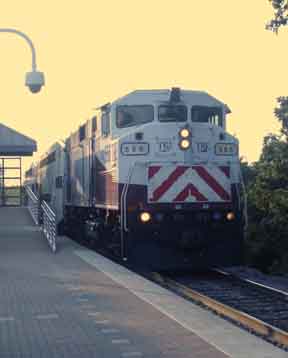
THIS YEAR, the return of DST was an entirely different situation. Between the shorter commute time and the mighty P7 light, a dark morning commute is quite different. THIS YEAR, the return of a dark commute means extra daylight AFTER work and THAT means I can do extra exploring after work in full daylight. The TRE train, in particular, beckons. In contrast to last year, where the TRE was a full hour's ride from work, now, it is just across the street from work and down the block.

P7 Bike Light to the Left, VW Jetta Lights to the Right
7:40 was the hour of dawn this morning. I'd been at work the better part of an hour. The TRE beckons!

The TRE May be a Waste of Taxpayer Money, But I'll Ride It!


Friday, February 4

First Tracks Through the Snow

More Ominous than Seeing Yesterday's Tire Tracks Was Seeing No Tire Tracks at All!

When I was first learning to ski, more recently than you might imagine, a Boeing engineer who had skied since he was a young child explained to me; “if you’re not falling, you’re not learning.” Later that year, the same Boeing engineer broke a number of bones while skiing. Well I did a lot of learning today on my very first bike commute in the snow/ice. First tracks, so to speak. It was GREAT fun! Fortunately, I was able to avoid breaking anything real important or even expensive. As you might suspect from the intro, I fell a lot and learned a lot. When I was growing up in Seattle, it would never have occurred to me to ride a bike in icy or snowy conditions. Who says Texas isn’t progressive? Besides, at LCI training, we were told that the SAFEST cyclists are those that ride every day, in all conditions. Apparently, they acquire skills that help them avoid crashes. Yeah, that’s it; I’m becoming a safer cyclist.


If You're Not Falling, You're Not Learning, Or So I Was Told
 When I went to bed last night, Northeast Tarrant County had a mixture of bare patches and slick ice. My commute strategy was laid out and even written down, here. However, our weather forecasters got it all wrong and, instead of a trace of snow and a few flurries, we got snow accumulation. Now, you have to remember this is North Texas, so our accumulation ranged from a couple of inches to about seven, depending on the particular locale. Had slick ice not still been hiding beneath the snow, it would have been very simple and almost trivial to pedal the whole way in. Simply start out carefully, don’t make rapid course changes, and leave lots of room for stopping. I’d have easily have beaten my pre-ride time estimate for the commute.

I Went Back for Rain Pants
As it was, things were more challenging. Leaving home, I rode without any trouble for most of a block. Suddenly, I was on the ground, conducting a test of whether my helmet would live up to its CPSC approval. At this point, I headed back to the house to get my rain pants. It was obvious that some water resistant layer would be needed to avoid soaking my pants if I was to continue as I was determined to do.

Snow/Ice Commute Pattern
In areas where the road had dried out before the snow, riding was easy and pleasant, though I found that, as in skiing moguls, you want to go the “right speed.”The right speed is “just right;” not too fast and not too slow. My “right speed” and your “right speed” would be different. On the other hand, in areas approaching intersections, and other places where slick ice underlay the snow, I found that it was sometimes problematic to stay upright. A WISE cyclist quickly learns to use extra caution when attempting to get back up AFTER a fall. It is one thing to fall, but it is quite another to fall a second time on top of your bike. OTOH, motorists, seeing such events, give an unusually wide passing margin if the cyclist managed to collect all the bits before they approach. Either that or they were amazed at bright yellow rainwear. Contrary to my test rides, each intersection posed a tradeoff dilemma. “Do I stay on the bike and fall down or do I fall down when I try to get OFF the bike?” For the record, in my current stage of expertise, I found that neither solution was entirely reliable. Intersections represent unusual problems for a cyclist, just as they do for our fair-weather brethren. About the only element of previous training I adopted is that I crossed wheel ruts much the same way as I would cross railroad tracks – at a 90 degree angle. That did seem to work. Maybe I was just lucky.

Toughest Commute Element
Surprisingly, I found that the toughest part of the entire commute was about a half mile along a separated multi-use path. Yesterday, I verified that the surface of the path was mostly bare and dry, and figured it’d be a snap to ride. Well, this morning, this being Texas, as you might guess, the path wasn’t plowed or sanded. In fact, I found that I was unable to tell where the path edge was and wound up walking my bike through scenic fields and eventually navigating based on recognizable landmarks. The path delayed my journey by about 15 minutes. It would have been worse but I finally encountered a stretch where I could tell where the path was, and that enabled me to make faster-than-pedestrian progress.

Surprisingly Nice Commute Element
I also encountered a pleasant surprise. Bedford-Euless road, a long uphill stretch, turned out to be the simplest part of the entire morning journey, obviating my planned snow route. I started up in the right lane and found that traction was reasonable. Better yet, all my motoring friends were unwilling to test the snow-covered surface in the right lane and stuck to the two ruts in the snow. No falls at all going up that hill in my twelve foot bike lane, and even had some motorist been braver than the rest, motorists are able to easily stop if necessary while going uphill. It is going DOWN the hills where they get in trouble.

Lessons
Helmets
I was uncommonly glad I wore a helmet this morning. However, I have a number of helmet suggestions for novice snow and ice bike riders. First off, learn with a helmet nearing the end of its shelf life. Second, ignore any advice to discard a helmet once you have crashed with it. Since it is impractical to carry a half dozen spare helmets along with you, wait until you get home again before retiring the helmet. I think I hit my helmet hard about four or five times. While it may not have saved my life, it certainly was a lot more pleasant and satisfying to hear that “whack” than to imagine a “thud” from my unprotected head. This is an argument in favor of using the cheapest and oldest usable helmet you possess in these conditions. I was glad I was wearing my “Wally World Special” and not my bike shop Giro helmet. I regret not wearing an older cheap helmet, but my Schwinn helmet got melted in the Land Rover last summer.

Routing
I had a snow route. It worked OK for the trip home, but was completely inappropriate for the trip in. To keep this lesson short, I simply recommend being adaptable as you discover how the conditions marry up with your particular skills (or lack of same) and bike. Be especially wary of a bike path, or even a bike lane, unless you have past bad-weather experience with that path. Even in such situations, bad weather has many variations so what works one time may not work later. Just as motorists vary their route when it snows, it makes sense for cyclists to do the same. Unlike motorists, cyclists need to consider the capabilities of their chosen vehicle, as well as shortcomings of the motor vehicles that are usually so predictable.

Other Equipment
In my previous post, Justin cleverly commented about lowering the saddle and Big Oak mentioned good points about clipless pedals and handlebars. Well, while I’m not sure lowering the saddle would help avoid fall situations, it sure would have reduced the stress and wear and tear on my rain pants. “Best efficiency” is not the main objective when riding in snow and ice. Kudos to Justin for that one. Who’d have thought such wisdom about ice riding would come from Dallas?

Clipless Pedals Came from Ski Bindings
As for clipless pedals, Big Oak correctly provided the wisdom (of long Yankee experience) that locking feet in the pedals might avoid ligament damage in a fall. Fortunately, I avoided any such damage with my platform pedals, but a budding snow/ice biker should consider that clipless pedal systems are an outgrowth of ski release systems, which were specifically developed to mitigate skiing injuries. Also consider that ICEBIKE seems to favor clipless pedals, though they also talk about the Power Grip system that Velouria uses on her bike. In slippery conditions, these may be superior to more conventional toe clips and they certainly make shoe choice easier. In my case, I don’t think clipless was a real option, because I possess no cold-weather cleated shoes, and even heavy shoe covers would simply not last through “hoofing it” segments. In my mind, this remains an area for future investigation.

Big Oak also advocates keeping one’s hands on the handlebars when going down. I was fortunate in this regard, because I learned NOT to attempt to brace against a fall with one’s arm when I learned to snowboard. Snowboarders break wrists and skiers blow out knees. Roll with the fall. If you can do this, you are less likely to break bones and other valuable body parts. My take away from this is that learning to fall can be a useful skill for a cyclist. Once learned, it may also come in useful for a fall in more typical cycling conditions. Certainly learning to fall can do no harm.

Raingear is another area for attention. I use a yellow O2 rain outfit. It is light and compacts down well in a trunk bag. It is almost ideal for the occasional Texas rain storm. However, the pants are not going to work for you for snow/ice bike learning. Mine now look like they were run through a shredder. Between falling down and getting up and getting on and off saddles, these pants aborbed as much wear as they would in a decade of regular bike riding. If you’re going to learn to ride and fall, the pants better be able to take that. Shower’s Pass? The “High Vis Police” will NOT be pleased. My O2 pants are yellow and the Shower’s Pass replacements come only in BLACK. OTOH, I found no damage at all to my yellow O2 rain jacket. I think you want pants that can use suspenders. I found that mine would droop and then get ripped when I got back on the bike. Showers Pass will accept suspenders. REI sells Showers Pass and I even have a coupon. Hmm. Black it is.

My headlight was more or less irrelevant most of the time. While the mighty P7 was very bright, it wouldn’t show me where the invisible bike trail was any better than imitating a bike ninja. What’s more, I discovered that in cold and snowy conditions, one should not expect as much battery life as usual. My P7 winked out about an hour into the morning commute, even though I’ve only made two full commutes this week, along with several test rides (normally, my light will last for a full week of morning commutes). The old Cateye was more than adequate thereafter. In future, if I encounter days of ice/snow, I’ll simply turn the P7 down a notch so it can make it through a full week of commutes. Remember that if you ride in the snow and ice, you’ll be using your lights longer, which should be taken into account if you have battery-operated lights.

Last year, I found that at 11F, ski mittens were too warm. This year, at 17F, in the snow, ski gloves were too cold – and later they got too warm. Regardless, keeping the damp out was the main objective and they accomplished that. I have not yet found an ideal hand solution. I brought my cold weather cycling gloves, but they’re simply not designed to be jammed into the snow.

These Tires Would Have Kicked Butt in the Snow
Vittoria Cross XG Pro in 34c Width - And a LOT of Mud
The Tire Limit on this Bike is Generous
Despite their names, 28c Continental Grand Prix “4 Season” tires are not optimum for the snow, though I think they’re better than Armadillos. My Vittoria cyclocross tires would have made the snow almost trivial and probably would have helped with the slick stuff, but I really didn’t feel like changing all those tires on my single set of rims. Based on what I’ve heard, for serious ice, you want studded tires but in North Texas, we get conditions like this only rarely. Short of studded tires, probably the best setup would be tubular cyclocross tires such as Justine Valinotti talked about here. The advantage of such tires is they’re like snow tires for bikes and, being tubular, they can be run at VERY LOW tire pressure in the snow. Actually, if you are a cross racer with tubulars, just haul out your tubular cross rims and you’d be ready to go in the snow. While tubular are generally less puncture resistant than high quality clinchers, remember that there’s snow covering up many items that might puncture a tire.

Mounting and Dismounting
Over on Facebook, there is a thread about proper bike mounting/dismounting, with many amusing comments about me demoing ways not to mount a bike. Well, I wound up trying several different methods and found that “power position,” “scooter start,” “cowboy start” all had situations where they worked and others where they failed. All I can say is that one would be wise not to get overly enamored with any particular approach. Sometimes you’ll have to get the bike moving and then get aboard. Sometimes you’ll want to be aboard and then get the bike moving. Sometimes, you’ll test the conditions briefly via coasting along while you stand on a pedal. Sometimes you will be aboard and you’ll straddle scoot along a bit, trying to decide what the next action should be. In the snow, I vote for results over style or even what might be consistently successful in conditions where the bike wheels aren’t imitating sled runners.

Falling
I had some opportunity to contemplate the merits of falling to the right (drive side) versus falling to the left. Falling to the right puts expensive components, such as the derailleur, at risk of getting bent. On the other hand, falling to the right, in theory, puts you further away from any following automotive traffic, and the chain is less likely to pop off the chain ring. At my level of expertise, I found this is mainly of academic interest to one that uncontrollably falls in both directions often. If any expert readers have a preference, I’d LOVE to hear it. Chandra suggests carrying a latex glove to help rerail a chain, but I would not have used such a glove this morning. The ski glove will simply have some chain lube on it forevermore and the latex glove would certainly not have fit over the ski glove. Speaking of falling, on the way to work, I fell too many times to count. On the way home, I didn't fall at all. There's SOMETHING to be learned in THAT particular bit of trivia as well.

Walking
Better Choices Were Available
Than Costco Court Classics
Walking is not as reliable as one might imagine. Unless you are using clipless pedals, simply use the best traction warm shoes/boots that you possess. This is an area in which I could have done a lot better than the aging “Costco Court Classic” shoes I use to ride to work in most days, but hind sight is 20-20. If you are a lady, I suggest you forgo the stylish footwear for the snow ride and stick to sensible footwear. Remember, if it is too slippery to ride, it is probably not ideal traction for walking, either.


Wrapup
It was a good commute, and I took quite a few pictures that follow. Would I do it again? ABSOLUTELY, but I think some non-snow days next week are pretty sweet as well. I think I have to think about the rain pant issue in particular...

Entrance to the Bedford Path. I Was Shortly to be Totally Lost and Reduced to Finding my Way Via Landmarks
There'd Been One Pedestrian Before Me. I Lost His/Her Trail in My Own Wanderings

Top of the Last Hill Before Work. Going Up the Hill Wasn't Hard. I Did Fall Trying to Get to Here from the Arterial as a Pedestrian - Twice
As You Can See, Traffic Was Not Real Heavy

Motorist Wonders What the Crazy Cyclist is Doing Taking Pictures - Or Maybe She's Wondering if She'll Make the Left Turn

When You Turn Pedestrian, You Don't Worry About Newly Erected Signs Like This One
Interestingly, They Were Clearing Sidewalks at the Elementary School in the Photo, Even Though School was Cancelled
I Clipped an Amusing Earphone Story Associated with this Shot

A Plastic Bag Makes Sure the Saddle Won't be Wet at the End of the Day
The Lock Was My Mini U. The Lock I USUALLY Use Was Frozen

This Road was Difficult to WALK on in the Morning. I Fell Twice on It
By Afternoon, Riding it was Easy. Look, Ma, No Falls!


Treacherous Spots Remained in the Afternoon, But They Were Localized


Almost Home, Buddy Rests While I Get Some Warm Liquid

 
Even the Smooth Conti Tires Accumulated Snow